
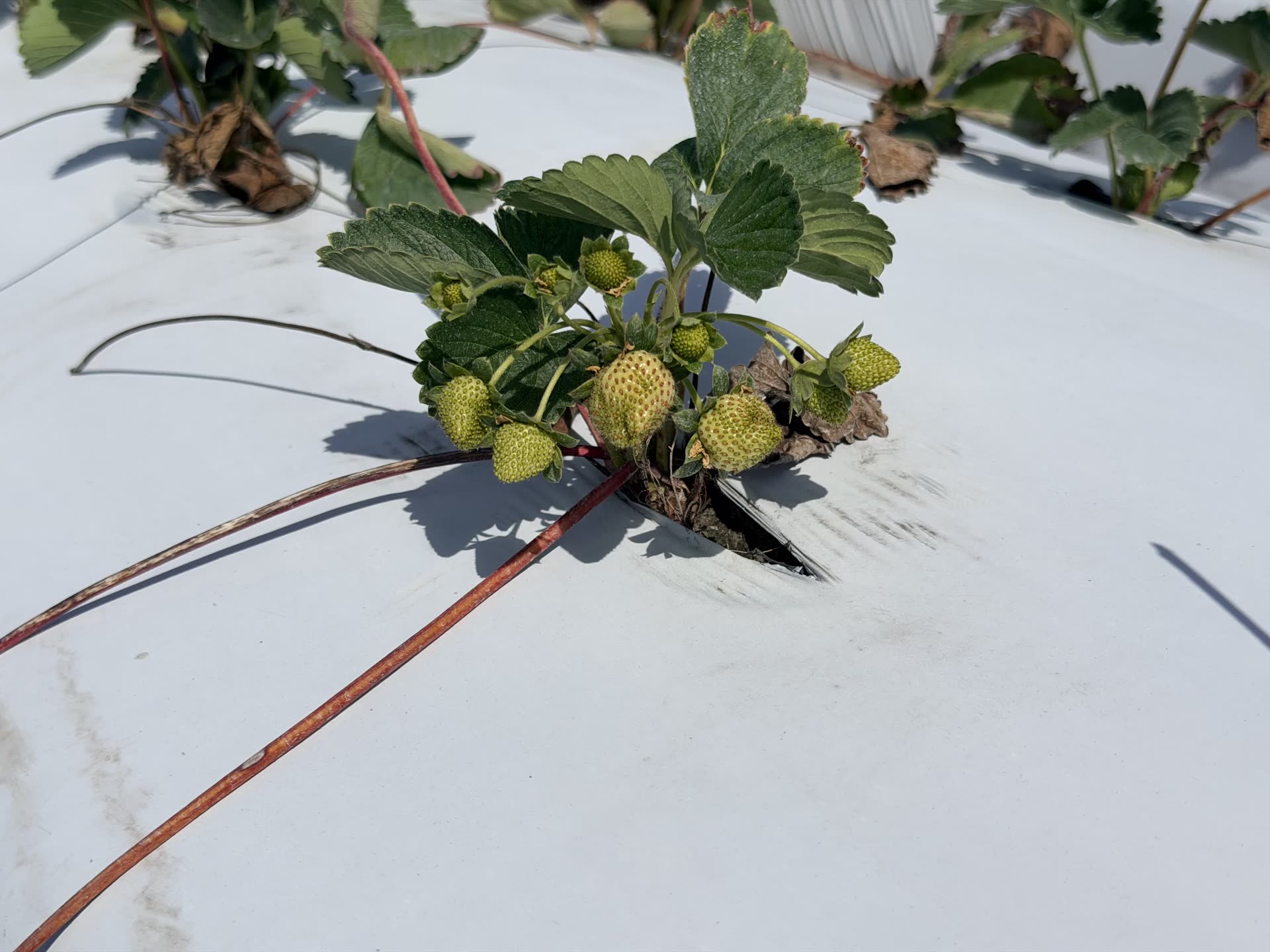

Strawberries in the Southeast want their nitrogen early, their boron and calcium at bloom, and a leaf test before anyone guesses at a fix. This guide walks through what to feed and when, from Plant City beds that are already picking by Thanksgiving up to Carolina fields that won't pick until late April. It's written for the grower deciding on a program, the dealer or distributor stocking for one, and anyone with a backyard row who searched “best fertilizer for strawberries.” Chemical Dynamics has made fertilizer in Plant City since 1973, so the first growers you'll meet here are our neighbors.
When do strawberries get planted in the Southeast?
Across the Southeast, plasticulture strawberries go in between early September and late October. The farther south the field, the later the planting and the earlier the first pick. A Plant City berry and a Piedmont berry share a planting month and almost nothing else on the calendar.
Planting Harvest Spring harvest
| Area | Planting window | Harvest |
|---|---|---|
| West-central Florida (Plant City) | late Sept to late Oct | late Nov through March |
| Alabama | Oct 1–15 | spring |
| NC lower Piedmont and Coastal Plain | 1st–2nd week of Oct | late April or early May, for 6–8 weeks |
| NC upper Piedmont, Virginia Tidewater | late Sept to 1st week of Oct | late April or early May, for 6–8 weeks |
| NC and Virginia mountains | early Sept | spring |
Planting windows outside Florida come from NC State Extension's planting-date guide (Hoffmann, McWhirt and Samtani), and the NC harvest window from NC State's plasticulture page. Bare-root plants go in three to five days ahead of plugs.
Plant City went first
CDI's hometown is where the region's season starts. Sam Astin began setting plants on his Plant City farm September 24 and was about 80% done by mid-October, he told Specialty Crop Grower. Somerfield Farms told FreshPlaza on October 13 that its planting was finished. UF/IFAS counts about 16,000 Florida acres across Hillsborough, Manatee and Polk counties, mostly Ember, Encore and Florida Brilliance (UF/IFAS).
It's been a dry fall up and down the region. The October 22 Drought Monitor had parts of Hillsborough County in moderate to severe drought, and Clemson Extension agents called Midlands and coastal South Carolina soils dry in their September 21 field update. Bare-root Florida transplants run on eight to twelve days of daytime sprinklers before they can take up much fertilizer (HS1376), and cycling those heads on and off cut water 50 to 75% in UF trials with similar yields.
What's the best fertilizer for strawberries?
On Southeast plasticulture, the best strawberry fertilizer is a preplant charge worked into the bed, then nitrogen fed through the drip while the plant is growing. A bag of 10-10-10 is what most garden guides suggest, and it's fine for a backyard row. On a commercial bed it runs into a problem: once the mulch is down, nothing granular gets in until the plastic comes up.
How big that preplant charge is depends on where you farm. UF/IFAS caps Florida preplant nitrogen and potash at about 30 lb an acre each (CIR1141). North Carolina's state agronomic division puts about 60 lb of nitrogen down before bedding, roughly half of a 120 lb season, with potash around 120 lb on a soil-test basis (NCDA&CS fertility manual). Both put the phosphorus, lime and micronutrients in before the plastic.
That makes the soil test worth more than any bag. An east Hillsborough field that has grown berries for twenty years may already hold more phosphorus than the crop will use. In the Carolinas the usual miss is pH. NCDA&CS calls low pH the most common problem in the state and wants mineral soils at 6.0 to 6.2, limed three to four months before bedding.
When should you fertilize strawberry plants?
It depends on whether your plants fruit through the winter or sit out the winter and fruit in spring. Florida feeds hard in the fall. The Carolinas, Virginia and the upper South feed hard in the spring.
Florida: front-load the fall
Start feeding in week 3 after transplant and put the heaviest nitrogen into weeks 3 through 8. That's the clearest result from Shinsuke Agehara's 2023–24 trial at the UF/IFAS Gulf Coast Research and Education Center in Balm (FSREF report). He held off for two weeks while plants rooted, then fed four cultivars at 0 to 3 lb N an acre a day in three six-week windows.
See the numbers
| Weeks after transplant | Suggested N, lb/acre/day | What extra N did in the trial |
|---|---|---|
| 1–2 | none, sprinklers only | Establishment period |
| 3–8 (early) | about 2, some cultivars 3 | Florida Brilliance total yield up 140% at 3 lb vs none |
| 9–14 (mid) | 1–2, by cultivar | Gains of 71–85%; Brilliance slipped above 2 lb |
| 15–20 (late) | about 0.5 | No meaningful yield gain in any cultivar |
The older UF/IFAS schedule climbs instead, holding N at 0.6 lb a day and raising it to 0.75 in February and March (CIR1141). Agehara's numbers say the February push comes too late to matter. Medallion wanted the most nitrogen in his trial, Pearl '109' and Sensation the least, and he suggests holding leaf N at 3.0 to 3.5%.
Carolinas and points north: wait for spring growth
A Piedmont plant takes its fall nitrogen from the preplant charge, then goes quiet under row covers through December and January. NCDA&CS starts drip nitrogen as soon as new growth shows in late winter and says not to wait, because demand climbs fast (NCDA&CS).
The working rate is about 0.75 lb N an acre a day, with a range of 0.5 to 1 lb set by petiole tests, for about 60 lb across the spring. Deep sand needs the top of that range and heavier ground the bottom. Their research found weekly, every-other-week and monthly injections all yielded about the same, so the schedule can fit the farm.
Can you fertilize strawberries while they're fruiting?
Yes, and across most of the Southeast you have to. A Plant City plant set in early October is carrying fruit by Thanksgiving and keeps picking into March. In North Carolina the spring feeding runs right through a six-to-eight-week harvest that starts in late April or early May.
The trick is easing off as picking goes on. In Agehara's Florida trial, nitrogen past week 14 added no yield. NCDA&CS has Carolina growers watch petiole nitrate climb to 3,000 to 4,000 ppm by early harvest, then let it slide to about 500 ppm by the last pick. Above 10,000 ppm, they warn, yield and berry firmness can drop.
Potash is the other half of the question, since plenty of people search for a high-potassium strawberry fertilizer. UF/IFAS fertigates K2O on the same 0.6 to 0.75 lb a day ceiling as nitrogen. North Carolina is more blunt about it: a soil-test rate of potash in the fall was enough in their research, and up to 200 lb more through the spring drip bought nothing.
Why are my strawberry leaves turning yellow?
Yellow between the veins of young leaves usually points to iron or manganese. On Florida sand it's often worst where well water runs high in pH or bicarbonate. In the Carolinas the soil problem usually runs the other way. NCDA&CS calls low pH the state's most common issue, and acid ground that never got its lime can leave plants short on calcium and magnesium. Older leaves yellowing all over is more often nitrogen running short.
Burned, crinkled tips on the newest leaves during a warm flush are the classic calcium picture, even when the soil holds plenty. Boron tends to show in the fruit instead, as nubbed or lumpy berries on plants that had decent pollination.
These look alike from a truck window, so pull a leaf before you spend on a fix. NCDA&CS samples the most recently matured leaf with its petiole every two weeks starting around March 1, earlier in southern and eastern fields, and grades it against these ranges (NCDA&CS):
| Nutrient | Sufficient in leaf tissue | Range |
|---|---|---|
| Nitrogen | 3.0–4.0% | Nitrogen sufficient range 3.0–4.0%, shown on a 0–5% scale |
| Potassium | 1.1–2.5% | Potassium sufficient range 1.1–2.5%, shown on a 0–5% scale |
| Calcium | 0.5–1.5% | Calcium sufficient range 0.5–1.5%, shown on a 0–5% scale |
| Boron | 25–50 ppm | Boron sufficient range 25–50 ppm, shown on a 0–300 ppm scale |
| Iron | 50–300 ppm | Iron sufficient range 50–300 ppm, shown on a 0–300 ppm scale |
| Manganese | 30–300 ppm | Manganese sufficient range 30–300 ppm, shown on a 0–300 ppm scale |
Boron is the one to handle carefully. When a field does need it, NCDA&CS suggests about 1/8 lb of actual boron an acre.
What have CDI's own trials shown?
Our one strawberry trial, on Festival from December 2008 through March 2009, finished about even with the untreated control. All three plots came in near 2,100 twelve-pound flats an acre. Festival has mostly given way to newer varieties since, but we're not going to dress that result up.
SOAR has a longer record on the vegetables that Southeast specialty growers often run alongside berries. Those trials ran an untreated control against SOAR Micronutrient Mix plus SOAR Bloom Spray at 2 or 3 quarts an acre, and the numbers below are final season totals.
See the numbers
| Crop | Season | SOAR vs untreated |
|---|---|---|
| Cucumbers | Spring 2008, 3 qt | 738 vs 534 marketable 55-lb cartons an acre, +38% |
| Tomatoes | Fall 2006, 2 qt | 2,656 vs 2,147 units an acre, +24%; ahead all three seasons tested |
| Bell peppers | Fall 2006, 2 qt | 1,542 vs 1,259 cartons, +22%; behind the control in spring 2005 |
| Zucchini | Spring 2007, 2 qt | 585 vs 489 bushels, +20%; cull fell from 59 to 42 |
| Squash | Spring 2004, 2 qt | 887 vs 798 bushels, +11% |
The lighter 2-quart rate matched or beat 3 quarts on most of these crops. Cucumbers were the exception.
Which CDI products fit a strawberry program?
Our strawberry products go on in two places. The drip products, pHury and KTS among them, go in at the injector, next to whatever nitrogen and potash the grower already runs. SOAR, Dyna Gold and the rest ride in the spray tank. The rates below come off the sheet I take out to growers around Plant City (CDI strawberry programs).
Through the drip
In Florida these are the products for weeks 3 through 8, when Agehara's trial says nitrogen pays best. pHury is the straight nitrogen, 15% N with 16% sulfur. pHury Phos carries 25% phosphate, though a berry field east of Plant City that has grown strawberries for twenty years may not need a drop of it, and the soil test will say so.
- pHury
Chemical Dynamics
pHury
15-0-0, 16% S
Drip: 1 gal/acre
The straight nitrogen for the weeks 3–8 window
View label & SDS → - pHury Phos
Chemical Dynamics
pHury Phos
8-25-0, 8% S
Drip: 1 gal/acre
Phosphate for beds the soil test says need it
Ask your rep → - pHury Mg
Chemical Dynamics
pHury Mg
10-0-0, 1.5% Mg, 12.7% S
Drip: 1 gal/acre
Nitrogen with magnesium and sulfur
Ask your rep → 
Dyna-Flo
KTS (Dyna-Flo 0-0-25 17S)
0-0-25, 17% S
Drip: 1 gal/acre
Potash through the drip on the same ceiling as nitrogen
View label & SDS →- CaTS
Chemical Dynamics
CaTS
6% Ca
Drip: 1 gal/acre
Calcium and sulfur for the injector
Ask your rep → - DynaCal Calcium 10.25%Drip or spray
Chemical Dynamics
DynaCal Calcium 10.25%
10.25% Ca, sorbitol-chelated
Drip: 1 gal/acre
The only product on the sheet that works in the tank or the drip
View label & SDS →
Compare in a table
| Product | Analysis | Injection rate |
|---|---|---|
| pHury | 15-0-0, 16% S | 1 gal/acre |
| pHury Phos | 8-25-0, 8% S | 1 gal/acre |
| pHury Mg | 10-0-0, 1.5% Mg, 12.7% S | 1 gal/acre |
| KTS | 0-0-25, 17% S | 1 gal/acre |
| CaTS | 6% Ca | 1 gal/acre |
| DynaCal | 10.25% Ca, sorbitol-chelated | 1 gal/acre |
KTS earns its place in Florida, where UF/IFAS feeds potash through the drip on the same ceiling as nitrogen. A Piedmont grower who put a soil-test rate of potash down in the fall can probably leave it in the shed until spring is over. North Carolina's own trials found the extra spring potash bought nothing.
In the spray tank

SOAR
SOAR Micronutrient Mix
Fe 3%, Mg 1.5%, Mn 0.6%, B 0.5%, Zn 0.5%, Mo 0.02%, Cu 0.01%
Spray: 3–4 qt/acre × 3
Season-long base program
View label & SDS →
SOAR
SOAR AP (Advanced Performance)
Mn 4%, S 4.5%, Zn 2%, Fe 0.75%, B 0.5%, Mg 0.5%
Spray: 3–4 qt/acre × 3
New leaves yellowing between the veins, manganese short on high-pH sand
View label & SDS →
SOAR
SOAR Bloom Spray
Ca 4%, B 1%, Mg 1%, Mo 0.02%
Spray: 1–2 qt/acre at early bloom
Fruit set, before boron gaps turn into nubbed berries
View label & SDS →
Dyna Gold
Dyna Gold Calcium 8.25%
8.25% Ca, glucoheptonate-chelated
Spray: 1–2 qt/acre
Tip burn on the newest leaves during a warm flush
View label & SDS →- DynaCal Calcium 10.25%Drip or spray
Chemical Dynamics
DynaCal Calcium 10.25%
10.25% Ca, sorbitol-chelated
Spray: 1–2 qt/acre
The same calcium job at a higher analysis
View label & SDS → 
Dyna Gold
Dyna Gold Vegetable Mix
N 4%, Fe 1.75%, Mg 1.5%, Ca 1%, Mn 0.75%, Zn 0.75%, B 0.05%
Spray: 2 qt/acre
Vegetables grown alongside the berries
View label & SDS →
Dyna-Flo
Dyna-Flo 5-15-1
5-15-1
Spray: 4–6 qt per 100 gal
Transplants slow to take hold during establishment
View label & SDS →
Compare in a table
| Product | What it carries | Spray rate | Where it fits |
|---|---|---|---|
| SOAR Micronutrient Mix | Fe 3%, Mg 1.5%, Mn 0.6%, B 0.5%, Zn 0.5%, Mo 0.02%, Cu 0.01% | 3–4 qt/acre, 3 applications | Season-long base program |
| SOAR AP | Mn 4%, S 4.5%, Zn 2%, Fe 0.75%, B 0.5%, Mg 0.5% | 3–4 qt/acre, 3 applications | New leaves yellowing between the veins, manganese short on high-pH sand |
| SOAR Bloom | Ca 4%, B 1%, Mg 1%, Mo 0.02% | 1–2 qt/acre at early bloom | Fruit set, before boron gaps turn into nubbed berries |
| Dyna Gold Calcium | 8.25% Ca, glucoheptonate-chelated | 1–2 qt/acre | Tip burn on the newest leaves during a warm flush |
| DynaCal | 10.25% Ca, sorbitol-chelated | 1–2 qt/acre | The same calcium job at a higher analysis |
| Dyna Gold Vegetable Mix | N 4%, Fe 1.75%, Mg 1.5%, Ca 1%, Mn 0.75%, Zn 0.75%, B 0.05% | 2 qt/acre | Vegetables grown alongside the berries |
| Dyna-Flo 5-15-1 | 5-15-1 | 4–6 qt per 100 gal of spray | Transplants slow to take hold during establishment |
SOAR Micro and SOAR AP share a rate, 3 to 4 quarts three times a season, and look interchangeable on paper until you reach the manganese column. AP carries 4% to Micro's 0.6%. On Hillsborough sand watered from a high-pH well, with the young leaves going pale between the veins and a leaf test short on Mn, AP is the one we'd send out.
DynaCal is the hotter of the two calcium products, and the only product on the sheet that works in the tank or the drip. Picture a warm week in December with tip burn on the new growth and the sprayer already spoken for. A gallon of DynaCal can go through the injector instead.
A rep narrows each range for your field from the transplant date, the variety and a recent leaf test. Full labels are in the ag label book, and you can reach me at 813-752-4950.
A note for dealers and distributors
If you cover more than one state, strawberry demand comes in two waves. Florida accounts start spraying right after transplant in October and keep going through March. Carolina and Virginia accounts barely move until spring growth starts in late winter, then run hard through a harvest that ends in early summer.
See the numbers
| Region | When growers start buying | When the program winds down |
|---|---|---|
| Florida (Hillsborough, Manatee, Polk) | October, at transplant | March |
| Alabama, the Carolinas, Virginia | Late winter, when growth resumes | June, as harvest ends |
CDI sells through dealers, not around them. For Florida strawberry accounts we run a 72-hour manufacturing lead time and 48-hour delivery out of Plant City, so a mid-season boron or calcium call doesn't sit waiting on a truck. Dealers who'd rather carry a program under their own name can talk to us about private label too.
Talk to someone who's seen these fields
Our plant at 4206 Business Lane sits a few minutes from the Plant City strawberry fields this post opened with. Whether you're setting up a fall program in Florida, a spring one in the Carolinas, or looking at a leaf test that came back low, call 813-752-4950 or find your rep through our strawberry programs page.
Keep reading
- Strawberry research from Plant City
The strawberry program page
Foliar and fertigation nutrition programs for Florida's October–March strawberry window, built by the team at our Plant City plant.
Read the program → - Strawberry nutrition programs
Products, rates and timing for the Plant City production window.
See the programs → - From the field
Preparing for Florida Strawberry Season: Nutrition, Yield & Insights
Field notes from E.W. Simmons & Fancy Farms — nutrition, yield planning, and insights from our October Plant City field visits.
Read the notes →
Sources
- Florida Strawberry Farmer Discusses Upcoming Season, Specialty Crop Grower, Oct. 28, 2026
- An early look at Florida's berry season, FreshPlaza, Oct. 13, 2026
- South Carolina Field Update, Sept. 21, 2026, Clemson Cooperative Extension
- Florida strawberry season bursts with sweetness, UF/IFAS, Dec. 3, 2025
- Fertilization of Strawberries in Florida (CIR1141), Hochmuth and Albregts, UF/IFAS
- Methods for Strawberry Transplant Establishment in Florida (HS1376), UF/IFAS, 2020
- Optimization of Nitrogen Fertilization Rate for Florida Strawberry Cultivars, Agehara, FSREF Research Reports 2023–24
- Strawberry Fertility and Nutrient Management, NCDA&CS Agronomic Division, rev. 2011
- Strawberries: Late Planting and the Use of Floating Row Covers, Hoffmann, McWhirt and Samtani, NC State Extension, 2022
- Plasticulture Production, NC State Extension Strawberry Growers Information
- Strawberry Nutrition Programs from Plant City, Florida, Chemical Dynamics
- Ag Label Book, Chemical Dynamics
- SOAR vegetable and strawberry field trial packets, 2004–2009, Chemical Dynamics internal data
- Strawberry and specialty crop rate sheet, Daniel Poppell, CCA, Chemical Dynamics